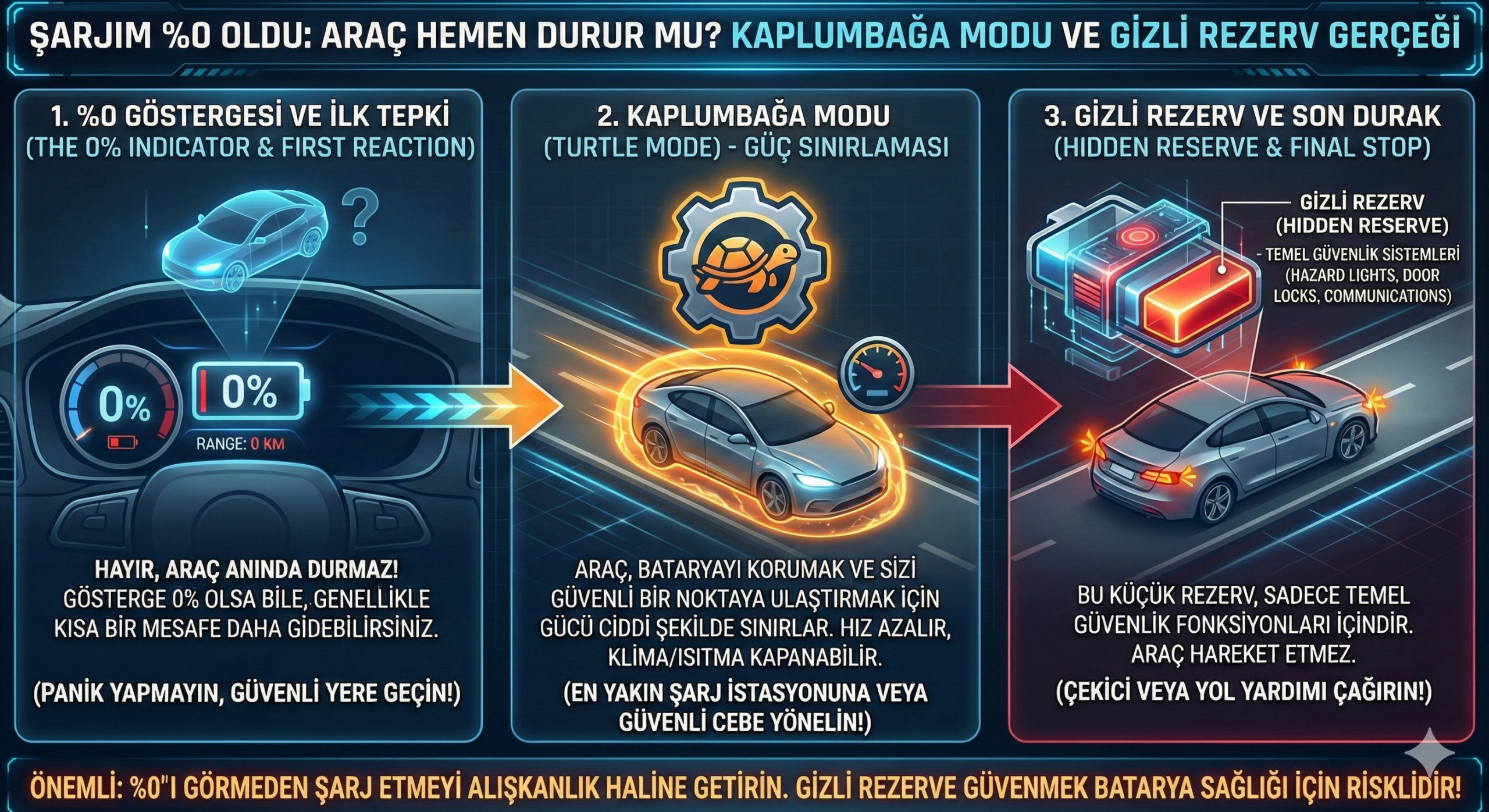
What Happens When Your EV Battery Hits 0%? Turtle Mode & Hidden Buffer Secrets (2026 Guide)
You are driving on the highway, the next charging station is miles away, and suddenly your battery indicator drops to the dreaded number: 0%. Your heart starts racing immediately. However, do not panic. EV manufacturers anticipated this scenario and designed a “Life Saver” feature within the system. In fact, even when your dashboard shows 0%, your battery still holds a “Hidden Buffer” of energy.
In this guide, we explain the limits of “Turtle Mode,” exactly how many miles you can drive after hitting 0%, and how to rescue your car without killing the 12V battery (bricking the car).
Don’t Panic: “Turtle Mode” Protects You
When the charge drops to a critical level (usually between 5% and 0%), a yellow or red turtle icon appears on your dashboard. Consequently, this mode forces you to use the remaining energy efficiently. The system automatically takes the following measures:
- Speed Limit: Even if you floor the gas pedal, the car restricts speed to 30-40 mph (50-60 km/h). Therefore, you cannot drive fast even if you want to.
- Comfort Restrictions: The system shuts down the AC heater and cooler; only the fan blows air. Moreover, heated seats turn off immediately.
- Torque Reduction: It prevents sudden acceleration. As a result, the car gains speed very slowly.
In conclusion, Turtle Mode acts as an emergency software designed to get you to a safe shoulder or, if you are lucky, to a charger.
The Hidden Buffer: How Far Can I Drive on 0%?
The answer varies by brand and model, but no manufacturer completely drains the battery at 0%. Because fully draining Li-ion cells damages their chemical structure. Generally, you can drive the following distances below 0%:
- Tesla Model Y / 3: Approximately 10-15 miles (15-25 km) depending on driving style.
- Ford Mustang Mach-E: About 5-8 miles.
- Togg T10X / Generic EVs: Approximately 6-9 miles (10-15 km).
However, never plan your route based on these numbers. Instead, use this energy strictly to exit the highway safely.
The Real Danger: Save Your 12V Battery!
The biggest mistake users make is pulling over at 0% and waiting for a tow truck with hazard lights and radio on for hours. In reality, this behavior can “brick” your car. Here is why:
- Firstly, when the High Voltage battery dies completely, it stops charging (sustaining) the small 12V battery.
- Secondly, if you keep hazard lights, radio, or interior lights on, the small 12V battery dies within 20 minutes.
- Finally, if the 12V battery dies, you cannot open doors, unlock the charging port, or release the parking brake.
Therefore, if your charge is completely dead and you pull over; turn on hazard lights (for safety) but immediately turn off all other electronics (AC, radio, phone chargers). Preserve the energy until the tow truck arrives.
Recovery Operations: What Should You Do?
Your car has stopped completely. In this case, follow these steps:
1. Focus on Safety
Try to pull the car to a flat surface off the road. Engage the parking brake. Then, set up your warning triangles.
2. Call a Flatbed Tow Truck
Call your insurance or roadside assistance. Specifically request a “Flatbed Truck.” Otherwise, towing an EV with wheels on the ground acts as a generator and destroys the motor.
3. Mobile Charging Service
Some roadside assistance companies offer “Mobile Charging Trucks.” They can come to your location and provide enough fast charge for 10-20 miles. Always ask for this service first.
Frequently Asked Questions About 0% Charge
We compiled the most common questions from stranded drivers. Click on the question to see the expert answer.
1. Driving & Range Questions
How the car behaves at zero percent.
How many miles can I drive on 0% charge?
What is Turtle Mode?
Does running out of charge damage the battery?
2. Towing & Recovery Methods
What to do when stuck on the road.
Is Regen Towing safe?
Can I push-start an electric car?
Do mobile charging trucks exist?
3. Systems & Hardware
AC, brakes, and 12V battery behavior.

Leave a Reply